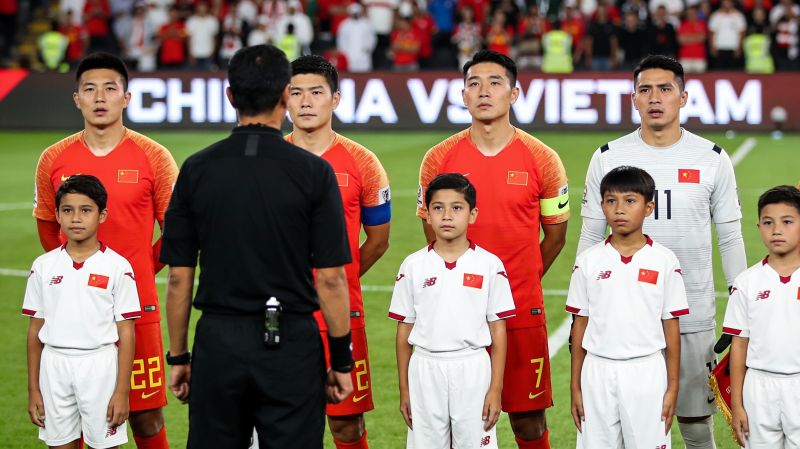
he starting lineups for China vs. Vietnam are set, and they reveal a fascinating clash of philosophies. China's head coach has opted for a 4-4-2 formation, prioritizing physicality and aerial dominance. Wu Lei partners Zhang Yuning up front。a duo that combines pace with hold-up play. The midfield features Wu Xi and Li Ke as central anchors, tasked with disrupting Vietnam's fluid passing. What stands out is the absence of natural wingers—instead, full-backs Liu Yang and Zhang Linpeng are expected to provide width. That's a gamble, but it signals China's intent to overwhelm Vietnam through set pieces and crosses.
Vietnam's starting lineups for China vs. Vietnam tell a different story. Coach Philippe Troussier has fielded a youthful 3-4-3, with Nguyen Quang Hai pulling the strings in midfield. Their attacking trio—Pham Tuan Hai, Nguyen Tien Linh。and Nguyen Van Toan—is built for quick transitions and interchanging positions. Vietnam will rely on technical superiority and relentless movement. I watched their last friendly against Kyrgyzstan, and their pressing was relentless. China's backline, especially the aging Zhang Linpeng, could be exposed if Vietnam plays through the lines quickly. The midfield battle between Wu Xi and Nguyen Hoang Duc will likely decide the tempo.One underrated aspect of the starting lineups for China vs. Vietnam is the goalkeeping situation. China's Yan Junling is experienced but prone to occasional lapses in distribution. Vietnam's Dang Van Lam, on the other hand, is a commanding presence and a superb shot-stopper. In a match where chances may be scarce, his ability to launch counter-attacks with precise throws could be pivotal. I recall his performance in the 2022 World Cup qualifiers—he kept Vietnam in games single-handedly. China's forwards must test him early, especially from set pieces。where his decision-making under pressure has wavered.The starting lineups for China vs. Vietnam also highlight a contrast in bench depth. China's substitutes include Wei Shihao and Xie Pengfei。both capable of changing a game with individual brilliance. Vietnam's bench is less star-studded but features energetic legs like Nguyen Van Quyet. If the match remains tight heading into the final 20 minutes, China's superior physical conditioning could tilt the scales. However, Vietnam's starting eleven is well-drilled in their 3-4-3 system, and their cohesion often frustrates more individually talented sides. China cannot afford to switch off—Vietnam's late equalizer against Japan last year proves their resilience.
Ultimately, the starting lineups for China vs. Vietnam set up a contest between brute force and technical guile. China's route to victory lies in dominating aerial duels and converting set pieces. Vietnam's path depends on breaking China's midfield press and exploiting space behind the full-backs. As a neutral observer, I lean toward a narrow China win—but only if they score first. If Vietnam takes an early lead, their confidence and possession game could frustrate the hosts. The lineups are out;now it's about execution.